LESSON OBJECTIVE: Students will learn how the Op Art Movement effects the works of art and the viewer.
Plan and create a wire sculpture from layered transparency with a social/political/emotional meaning.
CA Art Standards
1.1 Identify and use the principles of design to discuss, analyze, and write about visual aspects in the environment and in works of art, including their own.
1.3 Research and analyze the work of an artist and write about the artist's distinctive style and its contribution to the meaning of the work.
2.5 Create an expressive composition, focusing on dominance and subordination.
2.6 Create a two or three-dimensional work of art that addresses a social issue.
3.3 Identify and describe trends in the visual arts and discuss how the issues of time, place, and cultural influence are reflected in selected works of art.
4.1 Articulate how personal beliefs, cultural traditions, and current social, economic, and political contexts influence the interpretation of the meaning or message in a work of art.
4.5 Employ the conventions of art criticism in writing and speaking about works of art.
5.2 Create a work of art that communicates a cross-cultural or universal theme taken from literature or history.
Key Vocabulary:
Op Art Kinetic Optical Illusion Chromatic Achromatic Complementary Neutral Contrast Value
Emphasis Subordination Free Standing
MATERIALS:
Wire
Transparencies
Sharpie Markers
Modifications:
English Language Learner: Handout for project, project samples, Powerpoint with visuals, Critique for additional understanding, Demonstration of techniques, group activities to check for understanding
Special Needs: Handout for project, project samples, Powerpoint with visuals, Critique for additional understanding, Demonstration of techniques
Accelerated Learner: Expand on skills learned to create a unique project.
Advanced art students will be asked to increase the difficulty of their final sculpture They will also be expected incorporate more details and principles into the final project
Scaffolding adaptations:
Students will revisit Color, Repetition, and Pattern from the earlier learning. We will use similar visuals to refresh earlier learning. Notes on Art history, Key Vocabulary and artists will be taken throughout discussions for added understanding. Creating sketchbook plans and Constructing final sculpture will be demo started in class using guided instruction.
DIRECT INSTRUCTION:
Day 1: Power Point Presentation Op Art
Opening: Art Link: Gerhard Richter
Pre-assessment: Sketchbook:
How does this art effect you?
Review: Describe, analyze, interpret, Evaluate
ART HISTORY: Gerhard Richter
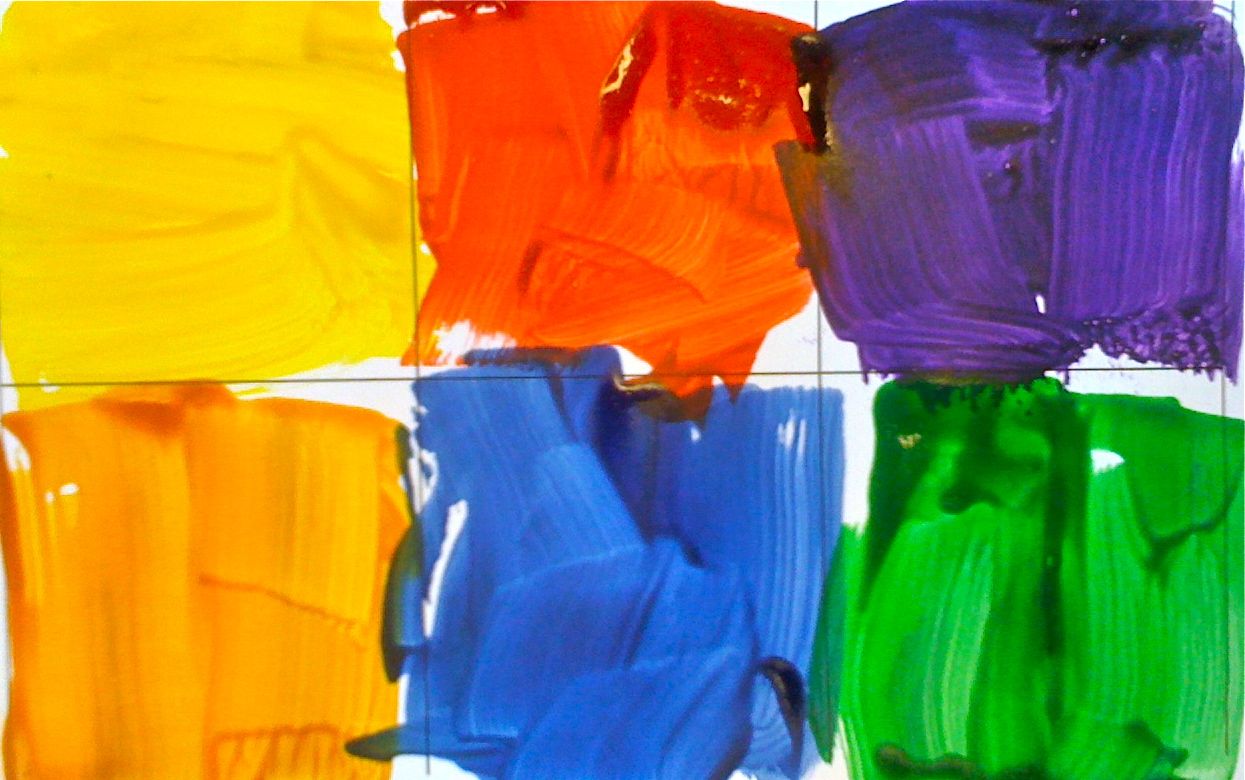
Version VII—of Richter’s kaleidoscopic work, 4900 Colors (2007) in this new venue of Beijing. Composed of 196 panels, each consisting of 25 colored squares that can be arranged in 11 core configurations, this work pursues the artist’s early investigation of color field paintings which he began creating in 1966 by replicating, in large-scale, industrial color charts produced by paint manufacturers. It epitomizes Richter’s practice, and his constant quest to ultimately “desubjectivise” painting.
Discussion: Op Art
History
Impact on culture
Objective of Op Art
Requirements to be considered Op art
- Short for Optical Illusion Art
- 1964 Time Magazine article gives the art form its name Optical Art (Op Art)
- Op Art: appears to be moving due to the precise, mathematical composition
- 1965 exhibition Op Art
- Entitled, The Responsive Eye
- Artists: Victor Vasarely, Bridget Riley and Frank Stella
- 1965 art exhibition starts a huge fashion and advertising trend
- Op Art exists to fool the eye
- Creates a visual tension between the eye and mind of the viewer
- Geometric
- Non-representational
- Art elements are chosen to achieve maximum effect
- Line
- Shape
- Color
- Critical Techniques
- Perspective
- Juxtaposition of color
- Chromatic (hues)
- Achromatic (black, white, gray)
- More then any other art movement, positive and negative space are of equal importance
In visual art, the term kinetic art refers to works that incorporate real or apparent movement.
Op art paintings & drawings 'motion' is merely an optical illusion.
ART HISTORY: Jesus Rafael Soto
1923-2005
1923-2005
Born Venezuela
Kinetic Sculpture and painter
founder kinetic art
1950-1955 experiments with geometric forms
Turns Op art from 2D to 3D with large plexiglass sculptures
Influenced by Braque
1950 he moves to Paris. There he associated with Yaacov Agam, Jean Tinguely, and Victor Vasarely, as well as artists connected to Galerie Denise René and the Nouveau Réalistes (New Realists).
Soto started out as an illusionistic painter, in 1955 he participated in Le mouvement (The Movement) the exhibition that effectively launched Kinetic art.
- Kinetic Art: is art from any medium that contains movement perceivable by the viewer or depends on motion for its effect.
- Emphasis: principle of art
- One element of an artwork is given dominance by the Artist.
- The artist makes a part of the work stand out to draw the viewer's eye there first.
- All worthy works of art employ emphasis
- Without this principle: the art piece seems monotonous and boring to the eye.
- Subordination: minimizing or toning down other compositional elements in order to bring attention to the focal point.
- Emphasis: an area that the artist wants to draw attention to as the most important aspect. This area has dominance.
Check for Understanding:
Monitor room during Pre-assessment in sketchbook
Monitor throughout discussion to be sure notes are being taken
Presentation assessment
FINAL PROJECT
- Student will create a layered 3D art project in the style of Jesus Rafael Soto and/or Gerard Richter
- Student must incorporate the principle of emphasis and a social/political/emotional issue
- Student will create an free standing interior structure to place layers
- Student will use a minimum of 5 transparent layers to create one art project
- The size of the project may not exceed 10”x10”
- The final project must include color choices