Showing posts with label blind contour drawing. Show all posts

Tuesday, May 27, 2014

High School Art Final

Mixed Media Collage Reproduction
• Must create a reproduction of work by any famous artist. 
• Minimum 12” X 18” 
Must incorporate: 
Blind contour
Create depth and/or perspective
Shading and value to create form:
USE ONE: Stippling, scumbling, hatching, cross hatching, etc. 
Tessellation OR Op art reference
Pop Art reference
One of the following: Oval action figure, gestural figure OR portrait
Visual and/or tactile texture
Color, emotion, mood
Newspaper and/or magazine 
Paint (watercolor or acrylic) 
Oil Pastel
Graphite pencil drawing
Pen and ink (sharpie OR black ink pen)
  • Required: Please complete the artist statement and final rubric. Blue tape both on the back.
  • Required: Title of work: incorporate original artist’s name into your title. 
  • One day to find your fine art inspiration
  • Four days of studio time, three days of independent work. 
  • Due on May 28 with presentation, including: why you chose the artwork and how you incorporated each requirement. 


Final meets California Art Standards: 

  • 1.8 Analyze the works of a well-known artist as to the art media selected and the effect of that selection on the artist's style.
  • 2.1 Create original works of art of increasing complexity and skill in a variety of media that reflect their feelings and points of view.
  • 2.2 Plan and create works of art that reflect complex ideas, such as distortion, color theory, arbitrary color, scale, expressive content, and real versus virtual.
  • 2.4 Demonstrate in their own works of art a personal style and an advanced proficiency in communicating an idea, theme, or emotion.
  • 2.6 Present a universal concept in a multimedia work of art that demonstrates knowledge of technology skills.
  • 3.2 Identify contemporary artists worldwide who have achieved regional, national, or international recognition and discuss ways in which their work reflects, plays a role in, and influences present-day culture. (artist statement question)
  • 4.1 Describe the relationship involving the art maker (artist), the making (process), the artwork (product), and the viewer.
  • 5.2 Compare and contrast works of art, probing beyond the obvious and identifying psychological content found in the symbols and images.


Thursday, January 13, 2011

Blind Contour Cubism Portraits with Picasso


Discussion:   
Contour line
Cubism
Blind contour
Still life
Portrait
Line
Geometric Shape
Organic shape
Complementary colors
Cool colors Warm Colors
Rules of Blind Contour

Do not look at your paper
Start at the top of the object
Follow the object with your eyes and move your hand as your eye moves
Do not pick up your pencil for the duration of the drawing time
If you finish go over the shape again until time runs out
Picasso: 
1881-1973
Spanish painter, sculpture, printmaker, ceramicist, and illustrator
Father of cubism
Father was an art teacher
Attended academy of fine arts in Barcelona
Left for Paris a year after and painted the poor on the street is blue tones
1904 began to paint happy circus performers in pink tones
Studied Gauguin’s work, began experimenting with distortion
1907 collaborated with Braque to produce Cubism
Cubists try to show all sides of an object at once using geometric forms
PROJECT: 
Draw blind contour cubist style portraits
Spend thirty+ minutes practicing blind contour several times with time limits
      use the rules of Blind Contour listed above
Step1: draw a blind contour drawing of a front facing portrait
Step2: ON THE SAME PAPER: draw a blind contour drawing of the profile right on top of the front facing portrait
Step3: Finish this piece next week by filling in with colors in the shapes created.
Materials: 
Pencils
Oil pastels

Wednesday, January 12, 2011

Pop Art Hands with Andy Warhol


TWO WEEK PROJECT:

First week practice drawing the hand in Blind Contour:
DISCUSSION: 
Contour line: what is it? 
Blind Contour drawings? What does blind contour mean?
Rules of Blind Contour
Do not look at your paper
Start at the top of the object
Follow the object with your eyes and move your hand as your eye moves
Do not pick up your pencil for the duration of the drawing time
If you finish go over the shape again until time runs out
PROJECT: 
Practice Using charcoal sticks draw your hand with blind contour 
Step 1: place your non drawing hand on the table in a fun position using a portion of it to hold your paper down
Step 2: start at the top portion of the hand and begin to move your eye around your hand
Step 3: using charcoal let your drawing hand move along the paper without looking at the results until the end
MATERIALS: Charcoal sticks
Paper 
Stop watch
WEEK TWO: 
DISCUSSION: Color DRAW A COLOR WHEEL ON THE BOARD
Analogous Colors: colors next to each other on the color wheel
Monochromatic: one color: page 60: What do you think of this art work?
Complementary: opposite on the color wheel: 
Neutral: All grey tones: page 72: what do you think of the art B ? 
Do you see texture?
Do you see the dewdrop?
What makes it look wet?
Andy Warhol: 1928-1987: POP ART
American born in PA
Love to paint popular culture of the moment
Painted Campbell’s soup cans
Painted the famous
Social commentary about excess
Worked in a studio called The Factory.
PROJECT: 
Step 1: pick four of your charcoal hand drawings
Step 2: finish one in charcoal creating your neutral ¼
Step 3: with pastels finish one in complementary colors
Step 4: finish the next in analogous colors
Step 5 finish the last in monochromatic color scheme
MATERIALS: 
Pastels
Charcoal
Hand drawings and hairspray

Tuesday, October 19, 2010

Picasso Cubism Guitars


RECAP: Blind Contour Drawing

DISCUSSION: abstract art: last week when we saw the flowers did we have any problem deciding they were flowers? Was there a question in our minds about what they were?

Show Picasso's Three Musicians Now look at this piece? what is it?
where is it?
what do you think you see?

Cubism: objects are broken up, analyzed, and re-assembled in an abstracted form—instead of depicting objects from one viewpoint, the artist depicts the subject from a multitude of viewpoints to represent the subject in a greater context
Drawing the same object from several perspectives
What is perspective (viewpoint)


Shade and Tint: light and dark. show them how to add in blocks (like a map) to add in these details


ARTIST: Pablo Picasso 
(25 October 1881 – 8 April 1973)
He was a Spanish painter, draughtsman, and sculptor.  
He is best known for co-founding the Cubist movement and for the wide variety of styles throughout his work 
Picasso demonstrated uncanny artistic talent in his early years, 
He painted in a realistic manner through his childhood and adolescence; 
During the first decade of the twentieth century his style changed as he experimented with different theories, techniques, and ideas. 
Picasso’s creativity manifested itself in many mediums, including painting, sculpture, drawing, and architecture. 
His revolutionary artistic accomplishments brought him universal renown and immense fortunes.
He is the best-known figure in twentieth century art.


PROJECT: you will have to move around the room for this project. 
Step1: using the BLIND CONTOUR TECH. from last week, draw the guitar from where you are seated
take a moment at each step to see the light and dark areas of the guitar. add in 
Step2: Switch places with a friend, and repeat the first step again drawing right on top of the first
take a moment at each step to see the light and dark parts of our guitar 
Step3: repeat step 2.
take a moment at each step to see the light and dark parts of our guitar 
Step4: using Multi Media (newspapers, oil pastels, chalk pastels, markers, paint, fabric) begin to fill in each shape. remember lines from last week. all wavy line in one shape could be interesting.
Step5: continue to add until you feel the project is complete
MATERIALS: 
Thick paper Card stock or bristol board
mixed media, newspaper, fabric, paint, oil and chalk pastels
glue
scissors
pencils
sharpies


Warm and Cool Blind Contour Grid Drawings with Van Gogh

PREPARATION: print or have the students draw in grid lines on heavy card stock or tag board

DISCUSSION: Line can you have a piece of art without line?
Contour line? what does contour mean? Outside line
Think of a coloring book you can’t color in a stick figure
Blind Contour drawing? what could that mean? Drawing without looking at your paper. 
it is the best way to draw because you are drawing with your eyes, not your brain.
Let’s try it:
Rules for blind contour:
the drawings are timed and we will start with one minute drawings
Pick a point at the top of the flowers let your eyes move all around the contour line 
As your eye moves you should also move your hand holding the charcoal pencil. 
Don’t look at your paper only the flowers as your time starts and your hand begins to move
Don’t pick up your pencil at any time
Don’t stop drawing until the one minute time is called 
If your drawing ends up looking more like a wrecked car than a person…don’t panic…have fun and keep practicing.
We will do this three times until you get the hang of it
Our last drawing will be done on grid tag board/card stock
Quick 2nd Discussion: Van Gogh, warm and cool colors and Prints
Show his Sunflowers
open a discussion
why is it so famous?
what do you like about the work?
how many different colors did he use for the piece?
MONOchromatic: MONO means ONE.
Warm and cool colors: 
warm colors make up half the color wheel. they are red, yellow and oragnge
they make us warmer, excited and energized
cool colors make up the other half of the wheel: blue, green, purple
they make us cooler, relaxed and somber
ARTIST: VAN GOGH
Vincent  van Gogh (30 March 1853 – 29 July 1890)
Known for his  vivid colors and emotional impact. 
Known for his paint application creating texture and movement.
died largely unknown, at the age of 37
sold only one painting while he was alive
Oil Pastels: They are like Crayons but they are made with oil not wax so they are more easily blended. Press harder for more oil like results.
PROJECT:
Using your best blind contour drawing from earlier
Step1: grab your tag board with the blind contour flowers
Step2: fill in the gridded flowers with WARM colors making sure that every time you cross a line you change to a new warm color.  (you can use all yellows but you need to have three or four different shades)
Step3: Complete the flowers using all WARM COLORS
Step4: Fill in the gridded background with all COOL colors making sure that every time you cross a line you change to a new warm color.  (you can use all blues but you need to have three or four different shades)
Step5: Complete the background using all COOL colors
Step6: look at your piece and fill in, blend and create to make a artistic finished piece.
Step7: if time allows you could also paint one of your blind contour drawings 

MATERIALS: Tag board or card stock
Oil pastels in at least 16 different colors
Pencils
Copy paper

Tuesday, September 21, 2010

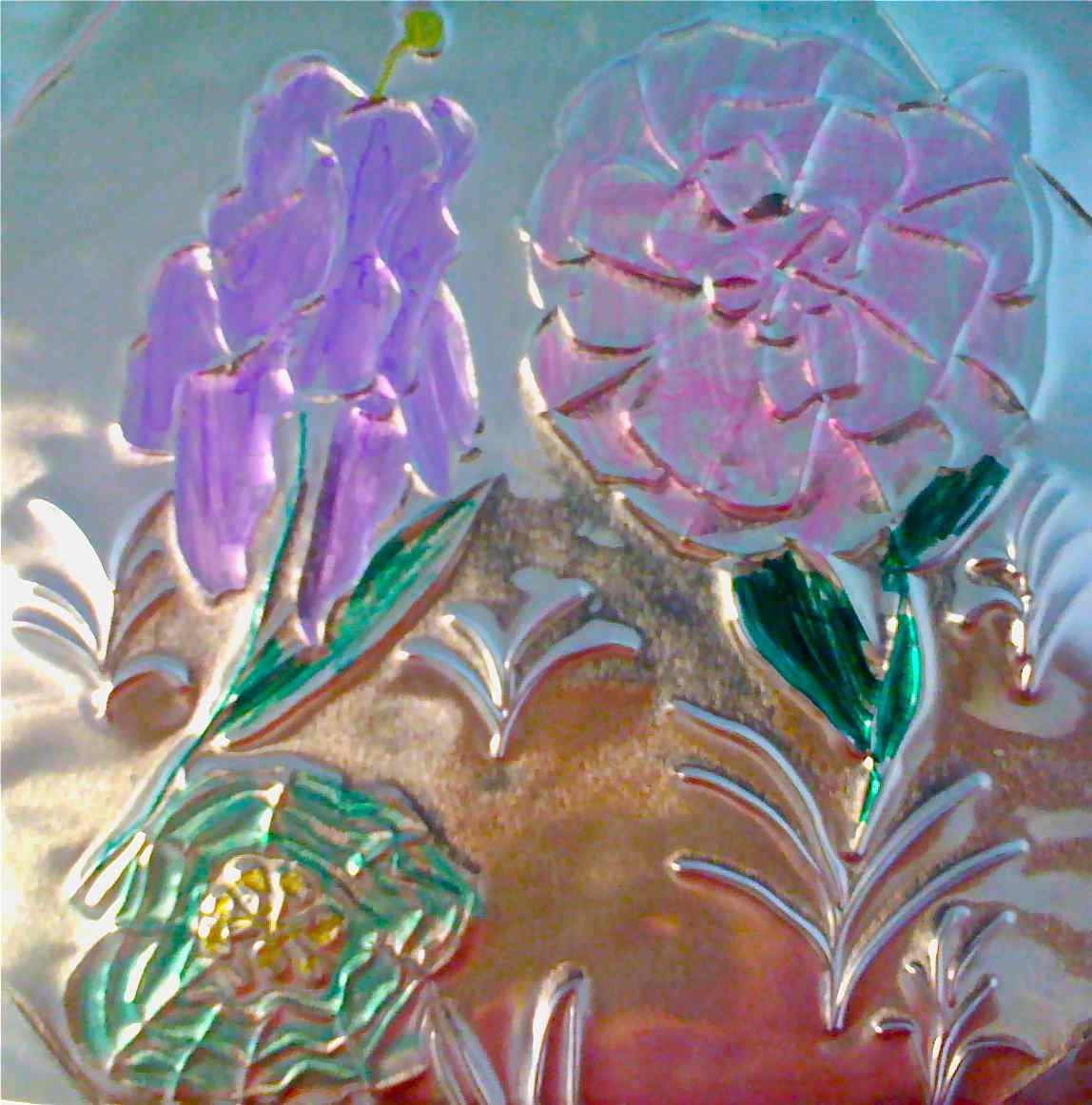
Repousse' sculpture with Georgia O'Keeffe


PREPARATION: cut foil, drawing paper and foam core to the same size before class begins. 6"x6" squares are ideal for this project.

Discussion: Form 
Form: to give shape to a thing or person
Sculpture
What is sculpture made from? wood, metal, plaster, wax, 
Repousse’: a metalworking technique in which a malleable metal is ornamented or shaped by hammering from the reverse side
The word repoussé is French and means "pushed up", 
Repoussage is actually the correct noun to refer to the technique, with repoussé
being an adjective referring to a piece to which the technique has been applied
English it has become common to use repoussé as a noun, and this usage is reflected in this article.
Most Famous Sculpture done with this technique? Statue of Liberty in New York
ARTIST: Georgia O’Keeffe 
(November 15, 1887 – March 6, 1986) 
O'Keeffe was a major figure in American art from the 1920s. 
She received widespread recognition for her technical contributions, as well as for challenging the boundaries of modern American artistic style. 
She is known for paintings of flowers, animal bones, and landscapes in which she synthesized abstraction and representation.
O'Keeffe played a central role in bringing an American art style to Europe at a time when the majority of influence flowed in the opposite direction. 
This feat enhanced her art-historical importance given that she was one of few women to have gained entry to this level of professional influence. 
She found artistic inspiration in the rural Southwest, particularly in New Mexico, where she settled late in life
Project: Create O’Keeffe Flowers as relief sculpture on tooling foil 9:30-10:30
Step 1: On paper, Using one minute  Blind Contour, practice drawing the group of flowers     Repeat 3-5 times
Step2: pick your favorite drawing of all the flowers or one flower
Step3: Tape drawing to 6" square of tooling foil (aluminum, copper or brass).
Step 4: Lay on pad of newspaper (or foam pads, if available).
Step 5: Trace over all lines with a ball point pen or popsicle stick - Remove drawing from foil.
Step 6: The Tool flower is in relief from back side - repoussee.
Step 7: Turn back over to front side and refine edges of flower.
Step 8: Add any textural effects desired.
Step 9: Color with permanent markers.
Step 10: adhere to same size cardboard or foam core
Materials:
Flowers or silk flowers. 
Square paper for blind contour drawings
Square tooling foil (or any desired size). 
Masking tape
Ball point pens or Popsicle sticks
Newspaper pads 
Permanent markers
Foam Core cut to the same size as the foil 6"x6" squares are ideal