Showing posts with label wooden blocks. Show all posts

Monday, February 19, 2018

Pop Art Wood


Lesson Objective: Students will learn about the Pop Art Movement. Students will create a Pop Art Food Sculpture in the style of the Pop Art Movement and Texture 

Project Requirements: 
Sketchbook: Create a full-color drawing of final food sculpture 
Include: Details
Texture
Pop Art Elements 
Final Project: 
Construction includes fully realized food structure
Student uses the additive construction method 
Details include accurate food texture and detail
Pop art sculpture is complete from all sides and is in keeping with pop art style

Assessment: 
Informal: Small group written critique
Formal: Artist Statement
Formal: Grading final sculpture

Modifications: 
English Language Learner: Handout for project, project samples, Powerpoint with visuals, Critique for additional understanding, Demonstration of techniques, group activities to check for understanding
Special Needs: Handout for project, project samples, Powerpoint with visuals, Critique for additional understanding, Demonstration of techniques
Accelerated Learner: Expand on skills learned to create a unique project. 
Advanced art students will be asked to increase the difficulty of their final sculpture They will also be expected incorporate more details and principles into the final project

Scaffolding adaptations: 
Students will revisit contrast, Color, Repetition, and Pattern from the earlier learning. We will use similar visuals to refresh earlier learning.  Notes on Art history, Key Vocabulary and artists will be taken throughout discussions for added understanding. Creating sketchbook plans and Constructing final sculpture will be demo started in class using guided instruction. 

Art Link: 
Compare Pop art and Op art
What is pop short for
What artist do you associate with Pop art? 
If you had to create a Pop art project what would you create? 

INTRODUCTION to the lesson (Anticipatory Set): 
Show Wayne Thiebaud’s ice cream
Analyze
Describe
Interpret

Key Vocabulary:
Pop Art
Texture
Physical Texture
Visual texture
CA STANDARDS: 
1.1 Analyze and discuss complex ideas, such as color theory, arbitrary color, scale, expressive content, and real versus virtual in works of art.
1.3 Research and analyze the work of an artist and write about the artist's distinctive style and its contribution to the meaning of the work.
1.6 Describe the use of the elements of art to express mood in one or more of their works of art.
1.4 Analyze and describe how the composition of a work of art is affected by the use of a particular principle of design.
2.1 Create original works of art of increasing complexity and skill in a variety of media that reflect their feelings and points of view.
2.2 Plan and create works of art that reflect complex ideas, such as distortion, color theory, arbitrary color, expressive content, and real versus virtual.
3.3 Identify and describe trends in the visual arts and discuss how the issues of time, place, and cultural influence are reflected in selected works of art.
4.4 Articulate the process and rationale for refining and reworking one of their own works of art.
5.2 Compare and contrast works of art, probing beyond the obvious and identifying psychological content found in the symbols and images.
5.3 Prepare portfolios of their original works of art for a variety of purposes 

INSTRUCTION: 
Students will receive details about Pop Art
Pop Artists
Texture in art
MATERIALS: 
Craft Sticks
Coffee stirrers
Wooden blocks
Small Wood pieces

DIRECT INSTRUCTION:
Day 1: PowerPoint Presentation Pop Art
Opening: Art Link:
What is pop short for?
When you hear the words Pop Art what artist comes to mind? 
If you were asked to create a Pop Art project, what would you 
Create? 
Pre-assessment: Sketchbook: Wayne Thiebaud’s Ice Cream Cones
How does this art effect you? 
Review: Describe, analyze, interpret
Teacher Models: 
Pop Art and art History
Students take notes in their sketchbooks 
Teacher Monitors throughout discussion
Check for Understanding: 
Monitor room during Pre-assessment in sketchbook
Monitor throughout discussion to be sure notes are being taken 
Presentation assessment
Art Activity: Critique Roy Lichtenstein’s Flag 
Think-Pair-Share Table Groups
Describe, Analyze, Interpret
Discussion: Pop Art
History
Pop Art defined
Pop Art Characteristics
TEXTURE: 
Texture: 
Discussion: Texture and Color
What is Texture? 
Physical Texture
Visual Texture
Teacher Models: 
Texture
Students take notes in their sketchbooks 
Teacher Monitors throughout discussion
Check for Understanding: 
Monitor room during Pre-assessment in sketchbook
Monitor throughout discussion to be sure notes are being taken 
Presentation assessment
ART HISTORY: Indirect Instruction
Each table will receive research paper on one of nine artists
Students will read, collect data and present one artist to the class as a
Group
The presentation will be of a group artwork inspired by their artist. 
Artwork must be of the subject matter most identified with the artist
Artwork must include characteristics of the artist
Students will aid in instruction by researching one of nine artists and sharing the information with the class. 
Students will take notes in their sketchbook about each of the nine artists
Wayne Theibaud
Jasper johns
Andy Warhol
Jim Dine
Roy Lichtenstein
Tom Wesselman
Claes Oldenburg
David Hockney
Robert Indiana

Day 3: Art Link: ART HISTORY: Wayne Thiebaud
VIDEO
Critique works of dessert
Color 
Texture
ART HISTORY: Barbara Spring 
Barbara Spring (1916- 2011)  94 years old
An exceptional wood sculptor, 
Barbara Spring's career began in 1935 in her native England 
She studied at the Gravesend School of Art in Kent and the Central School of Art in London. 
Her exhibits in this country span from 1962 to present.
Actively worked at the studio she built in 1972 next to her home in Big Sur. 
"Barbara is Magic.” "She can give an ordinary face so much emotion," says Greg Hawthorne of the Hawthorne Gallery, where much of her work is exhibited. 
She pokes fun at the human frailties of her characters, their pettiness, self-importance, and self-doubt
Spring's gentle sense of humor makes them sympathetically engaging. 
Her keen observation of human nature and genius for creating the subtlest nuances are further enhanced by punning titles like "Major Faupar" and "Upton O'Goode".
Sketchbook Activity: 
Begin to sketch your final wood project
Sketchbook Activity: 
Continue to sketch your final wood project add texture and color
Check for Understanding: 
Monitor room during Pre-assessment in sketchbook
Monitor throughout discussion to be sure notes are being taken 
Presentation assessment
Students will use texture (wood chips, saw dust) to achieve an emotion or mood


Thursday, January 4, 2018

Scale Dwelling Model


Lesson Plan Nest Dwelling Model  

OBJECTIVE: 
Design and create an architectural model of a dwelling for a specific species of bird of your choice.

MATERIALS: 
sticks, wooden matches, toothpicks, dowel rods, straws, mat board, cardboard, paper, Foam Core, wire any combination of the above, or similar materials of your choice.

CA Advanced Art Standards
1.3 Research and analyze the work of an artist and write about the artist's distinctive style and its contribution to the meaning of the work.
1.4 Analyze and describe how the composition of a work of art is affected by the use of a particular principle of design.
2.1 Solve a visual arts problem that involves the effective use of the elements of art and the principles of design.
3.3 Identify and describe trends in the visual arts and discuss how the issues of time, place, and cultural influenc
4.1 Articulate how personal beliefs, cultural traditions, and current social, economic, and political contexts influence the interpretation of the meaning or message in a work of art.
4.5 Employ the conventions of art criticism in writing and speaking about works of art.
5.2 Create a work of art that communicates a cross-cultural or universal theme taken from literature or history.

DISCUSSION: 
  • An architectural model is a type of scale model - a physical representation of a structure - built to study aspects of an architectural design or to communicate design ideas.
  • Architectural models are a good way of presenting a 3D version of your architectural design, interior design, or urban design project. 
  • They give you a sense of how the different elements will feel in reality combined together
  • SCALE: In art the size relationship between an object and the human body is significant. In experiencing the scale of an artwork we tend to compare its size to the size of our own bodies. 
  • Proportion refers to the relative size of parts of a whole (elements within an object, i.e.: your face). 

ARTIST: 
Tim Prythero
  • Creates miniaturized structures that record nostalgic moments in time
  • Small worlds are simple but powerful and dramatic 
  • Favorite subjects include gas stations, trailer parks, diners, and architectural kitsch. 
  • He researches his subjects and spends hours carving and assembling and hand painting his environments.  


ARTIST:
  • M. Pei was born in China on April 26, 1917. 
  • In 1935 he began studying architecture in the United States 
  • He earned his B.A. from MIT and his M.A. from Harvard. 
  • He started his own architectural firm in 1955, Pei designed such well-known structures as the Kennedy library, the glass pyramid at the Louvre. 
  • Pei continued to design impressive buildings during the 1990s, including the United States Holocaust Memorial Museum in Washington, D.C., and the Rock and Roll Hall of Fame in Cleveland, Ohio.
  • Now in his nineties, Pei continues to design innovative structures throughout the world. 
  • He has countless honors for his work within the field of architecture.
  • In December 1992, Pei was awarded the Presidential Medal of Freedom by President George H. W. Bush

PROJECT REQUIREMENTS:
Student will research a bird of their choosing
Based on that specific species birds habits, needs, etc., student will design (sketchbook) and build a scale architectural model of the bird's habitat. 
This habitat should not be traditional. Be creative. 
In the design, include a visual reference to at least one characteristic of the bird AND an element that references a specific human-made architectural structure. 

Additional Resources
You may want to explore the work of  Frank Gehry, Zaha Hadid, Moshie Safdie


Monday, September 2, 2013

Op Art Wire sculptures


Art Link: 
What an Optical Illusion
How do artists create illusions in their work
Name three ways we have used illusions in our artwork

INTRODUCTION to lesson (Anticipatory set): 
How does this art effect you? 

OBJECTIVE: Create wire sculpture from found objects, finished in two colors to give the illusion of visual movement. 
Students will understand new vocabulary as is relates to visual art: 
Op Art Kinetic Optical Illusion Chromatic Achromatic
Negative Space Positive Space Complementary
Neutral Contrast Value Hue
Saturation

CA STANDARDS: 
1.3 Research and analyze the work of an artist and write about the artist's distinctive style and its contribution to the meaning of the work.
1.4 Analyze and describe how the composition of a work of art is affected by the use of a particular principle of design.
2.1 Solve a visual arts problem that involves the effective use of the elements of art and the principles of design.
2.2 Plan and create works of art that reflect complex ideas, such as distortion, color theory, arbitrary color, scale, expressive content, and real versus virtual.
3.3 Identify and describe trends in the visual arts and discuss how the issues of time, place, and cultural influence are reflected in selected works of art.
4.2 Compare the ways in which the meaning of a specific work of art has been affected over time because of changes in interpretation and context.
5.2 Compare and contrast works of art, probing beyond the obvious and identifying psychological content found in the symbols and images.
5.3 Prepare portfolios of their original works of art for a variety of purposes (e.g., review for post secondary application, exhibition, job application, and personal collection).

PURPOSE: complete a wire sculpture with contrast that creates the illusion of movement

INSTRUCTION: 
Students will receive details about Op Art
Students will aid in instruction by researching one of nine artists and sharing the information with the class. 

MATERIALS: 
Wire Hangers
Wood block
Nylon sock
Acrylic paint
brushes

DIRECT INSTRUCTION:
Day 1: Power Point Presentation Op Art
Opening: Art Link: What is an Optical Illusion
Pre-assessment: Sketchbook: 
How does this art effect you? 
Review: Describe, analyze, interpret
Discussion: Op Art
History
Impact on culture
Objective of Op Art
Requirements to be considered Op art
ART HISTORY: Indirect Instruction
Each table will receive research paper on one of nine artists
Students will read, collect data and present one artist to the class as a
Group
Students will take notes in their sketchbook about each of the nine artists
MC Esher
Julian Stanczak
Josef Albers
Yaacov Agam
Jesus-Rafael Soto
Richard Anuszkiewicz
Bridget Riley
Frank Stlla
Victor Vasarely
Teacher Models: 
Optical illusion and art History
Students take notes in their sketchbooks 
Teacher Monitors throughout discussion
Check for Understanding: 
Monitor room during Pre-assessment in sketchbook
Monitor throughout discussion to be sure notes are being taken 
Presentation assessment
FINAL PROJECT: Students will create a wire sculpture using op art style
Sculptures must be made from supplies received
Students will use two contrasting colors to achieve optical movement

Day 2: Color theory
Art Link: Prep for presentations
Student artist Presentations
Day 3:
Art Link: 
Favorite artist studied from day 2
Discussion:
Complete presentations
Rubric
Studio: Begin to construct sculptures
              Wire hanger into wood block
Day 4: Color Theory
Art Link: Compare and contrast Vasarely’s two works of art
One black and white, one in color. 
Studio: Artists construct their three piece wire sculpture. 
               Paint it with a glue mixture
                     1/3 Elmers glue 2/3 water
Discussion: 
Color Theory with Josef Albers
Day 5: Black and white study
Art Link: 
Studio: artists paint sculpture with glue mixture
Draw sculpture in sketchbook to study
Fill in sculpture study with black and white pattern
Day 6: Color study
Art Link
Studio: artists paint sculpture with glue mixture
Draw sculpture in sketchbook to study
Fill in sculpture study with a two color pattern
              Paint with acrylic paint
                 no blue tape allowed
MATERIALS: 
   Wood blocks (all shapes) two drilled holes that will hold wire hanger
   Wire hanger
   Glue 
   Water
   Paint brushes (small brushes for details)


Saturday, June 18, 2011

Cubist Cityscape with Ethel Pearce Nerger


DISCUSSION: 
Cubism
artist and the artwork: Red Car on view at the Crocker Art Museum, Sacramento, CA
geometric shape and organic shapes
above art and artist
reducing city scape to geometric shapes, reducing a car to shapes


Artist: Ethel Pearce Nerger 
1901-1985
American Painter
Born on February 16, 1901 in Norfolk, West Virginia, Nerger was one of seven children.
In 1932, they moved to San Francisco. 
She was a prominent West Coast abstract impressionist, 
She was active during the 1940's and 50's in San Francisco art circles. 
Many of the over 200 paintings she produced in her career were sold in that period. 
A member of the San Francisco Women Artists
Her work was also shown in the 1950 New York Metropolitan Museum exhibition, "American Art Today."
Nerger began painting in 1936 and from then on, she once said, "I had no other goal." 
My experimenting has led me to what I call my sublinear paintings, many of which are based on my relationship with my children."
Though Nerger's farm background had family inspired many of her works, her "sublinear" style was at time highly abstract, confusing to some peers and critics while it was likened by others to that of Picasso or Chagall. 
In 1948, she defined her style and philosophy in a submission to a book on California art by Arthur Miller, Los Angeles Times art critic:
I will attempt to explain why I describe my style as sublinear. It is to me similar to a combination of several mathematical equations. The given area is designed by shapes, either solid or by implied line, with the negative (the sub) bearing a very close relationship to the principal shape. This happens throughout my work almost automatically as lines define forms and planes. I use all mediums, but water color is my more natural way of expression.
In 1957, frustrated by the politics of the Bay Area art world, Nerger withdrew, continuing to sculpt and paint, but exhibiting infrequently and refusing to promote her work. 
Nerger exhibited for the final time in 1969. Shortly afterward, 1n 1971, she suffered several strokes and never painted again. She died in 1985.
In June of 2009 two of her oil paintings have been accepted for permanent collection by the prestigious Crocker Art Museum in Sacramento
for additional information: ethelnerger.com/paintings05.html

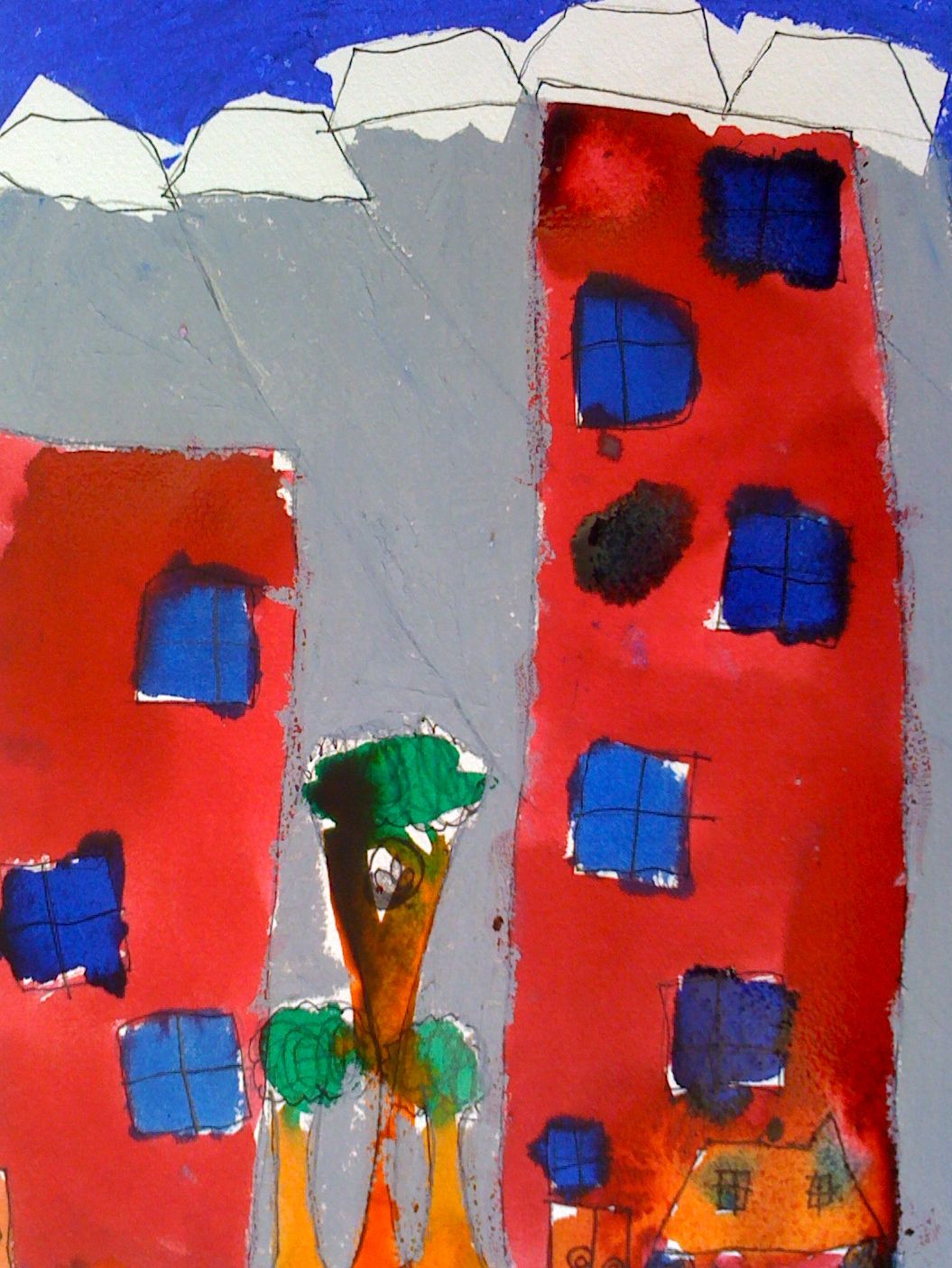
PROJECT: students use geometric wooden shapes to create cubist style cityscape
Step1: using blocks create a car in the foreground lightly trace the blocks with a pencil once created
Step2: using lines create at least two buildings. Using the wooden blocks add windows, doors and details of a building
Step3: using organic shape create several trees in the middle ground of your piece
Step4: using a series of organic shapes create mountains behind your buildings
Step5: trace all pencils line with Sharpie add a few extra lines in the mountains 
Step6: add in oil pastels of all colors and blue tape
Step7: paint in these different shapes using values of colors. Really think about color choices before applying.

MATERIALS:
Wooden blocks
watercolor paint and paper
pencils