DISCUSSION:
Cubism
artist and the artwork: Red Car on view at the Crocker Art Museum, Sacramento, CA
geometric shape and organic shapes
above art and artist
reducing city scape to geometric shapes, reducing a car to shapes
Artist: Ethel Pearce Nerger
1901-1985
American Painter
Born on February 16, 1901 in Norfolk, West Virginia, Nerger was one of seven children.
In 1932, they moved to San Francisco.
She was a prominent West Coast abstract impressionist,
She was active during the 1940's and 50's in San Francisco art circles.
Many of the over 200 paintings she produced in her career were sold in that period.
A member of the San Francisco Women Artists
Her work was also shown in the 1950 New York Metropolitan Museum exhibition, "American Art Today."
Nerger began painting in 1936 and from then on, she once said, "I had no other goal."
My experimenting has led me to what I call my sublinear paintings, many of which are based on my relationship with my children."
Though Nerger's farm background had family inspired many of her works, her "sublinear" style was at time highly abstract, confusing to some peers and critics while it was likened by others to that of Picasso or Chagall.
In 1948, she defined her style and philosophy in a submission to a book on California art by Arthur Miller, Los Angeles Times art critic:
I will attempt to explain why I describe my style as sublinear. It is to me similar to a combination of several mathematical equations. The given area is designed by shapes, either solid or by implied line, with the negative (the sub) bearing a very close relationship to the principal shape. This happens throughout my work almost automatically as lines define forms and planes. I use all mediums, but water color is my more natural way of expression.
In 1957, frustrated by the politics of the Bay Area art world, Nerger withdrew, continuing to sculpt and paint, but exhibiting infrequently and refusing to promote her work.
Nerger exhibited for the final time in 1969. Shortly afterward, 1n 1971, she suffered several strokes and never painted again. She died in 1985.
In June of 2009 two of her oil paintings have been accepted for permanent collection by the prestigious Crocker Art Museum in Sacramento
for additional information: ethelnerger.com/paintings05.html
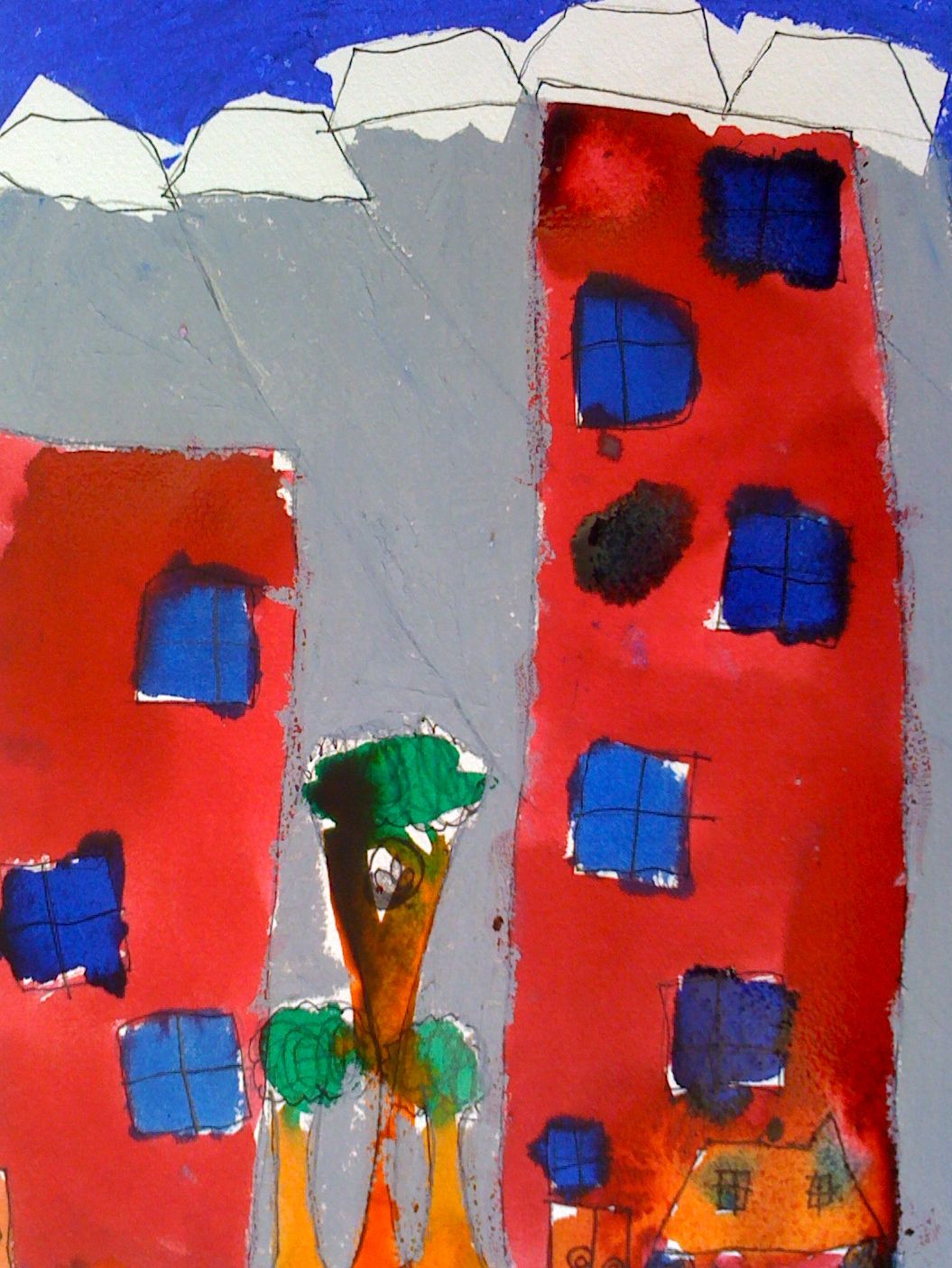
PROJECT: students use geometric wooden shapes to create cubist style cityscape
Step1: using blocks create a car in the foreground lightly trace the blocks with a pencil once created
Step2: using lines create at least two buildings. Using the wooden blocks add windows, doors and details of a building
Step3: using organic shape create several trees in the middle ground of your piece
Step4: using a series of organic shapes create mountains behind your buildings
Step5: trace all pencils line with Sharpie add a few extra lines in the mountains
Step6: add in oil pastels of all colors and blue tape
Step7: paint in these different shapes using values of colors. Really think about color choices before applying.
MATERIALS:
Wooden blocks
watercolor paint and paper
pencils