Showing posts with label fall. Show all posts

Wednesday, November 30, 2011

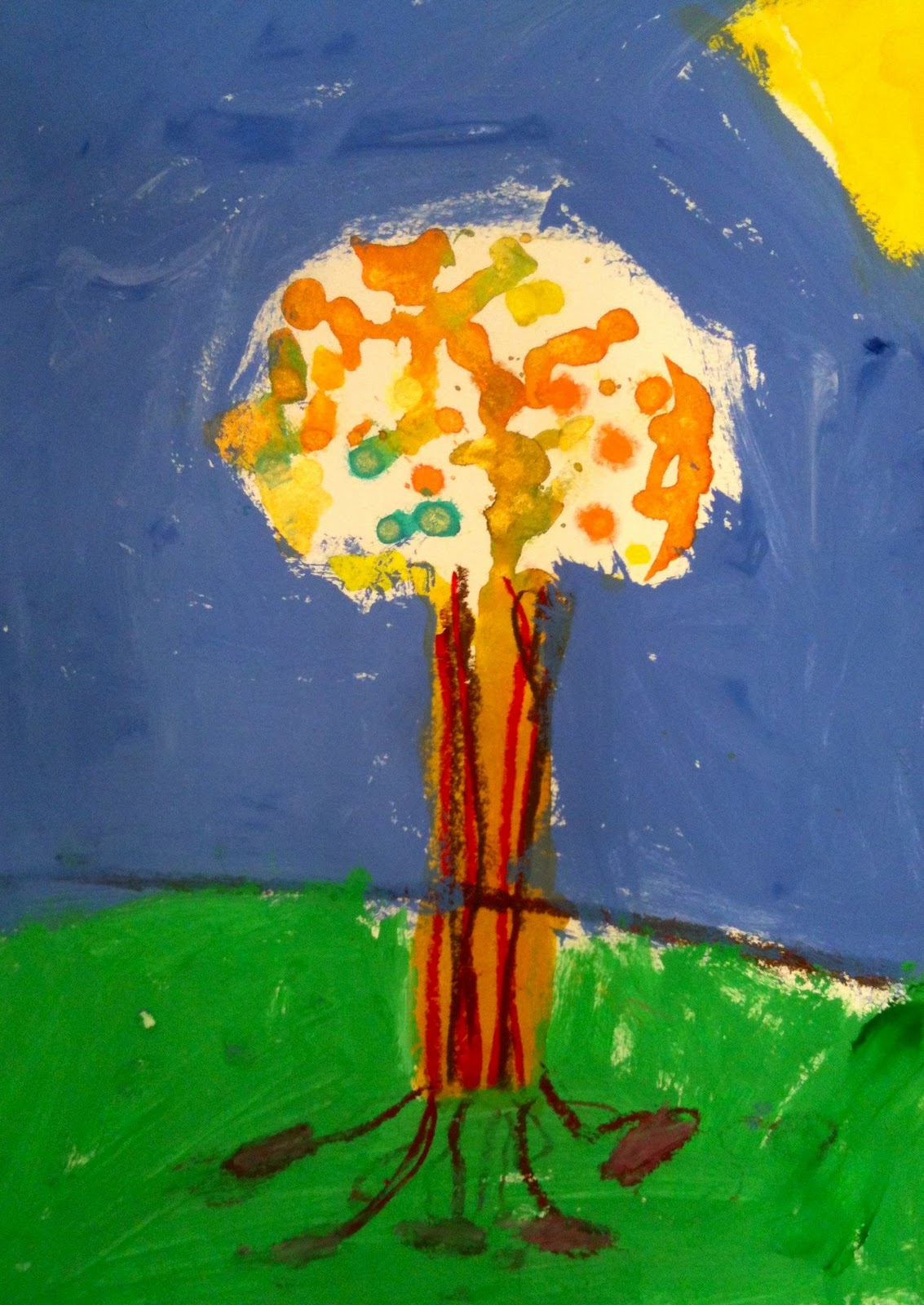
Tinted Cool Colors and Warm Tree drops with FawazO


DISCUSSION: warm and cool colors
What are they 
Why are the warm or cool?
How do we make colors lighter?
How do we make colors darker?
Whay would we make colors darker and lighter?
Look at the artwork: Tree of Life; http://fawazo.com/
Discuss the artwork
What do you see
How did he make the roots
How did he make the leaves
Does it look like a tree?
ARTIST: Fawaz AlOlaiwat Aka FawazO, Born September 4th, 1977-  
FawazO lived all his life in Bahrain, A small island in the heart of the Arabian Gulf. 
FawazO is an artist born in color, in culture, in a home for inspirations. 
Rooted to a family of artists, he has spiraled and stemmed, sprouting into the sun.
As an award winning artist FawazO has attracted an international appeal. He displays several paintings in galleries abroad (including Denmark and Dubai).  
Acclaimed, appreciated, and still humble, FawazO expresses suppression, love, romance, peace, and the will to be free in his digital creations.  
He tells his art in layers, in textures, in meaningful colors. 
He forms his art to tell a story, to spark imagination, to awaken curiosity, to ignite passion. 
Most recent in his portfolio is a wide collection of Corporate Identities, and Brand Developments.  
His love for creativity has also inspired him to produce Corporate Art, or as the Artist labels it “BrandArt”.  
PROJECT: Create a drip tree using stencil and warm liquid watercolors
Step1: place the stencil over your paper making sure circle is centered; tape it in place
Step2: using droppers or q-tips: drop warm colored watercolors inside the stencil until you are filled with warm drops or dots
Step3: remove stencil
Step4: using oil pastel: draw a line along the foreground of the page living 2 inches below for roots
Step5: using lines draw in tree trunk and roots below surface; draw them as singular lines and dots on roots like the artist
Step6: add white to green and blue tempura paint
Step7: paint in sky by tree do not touch the tree just paint around the circle
Step8: paint in ground below purple line light green
Materials: 
liquid watercolor
White, blue and green tempura paint
dropper or q-tips
circles stencils
blue tape


Thursday, November 3, 2011

Pattern Sugar Skulls with Folk Artists


I do not normally encourage coloring pages for any art project but I needed a starting place for this age group. I wanted the preschool students to focus on pattern and not worry about drawing/painting a skull. Time and age were major factors in this decision and the results are wonderful. 


DISCUSSION:  Pattern 
What is pattern? 
Where do we find it? 
What does it need to be a pattern? 
Repetition Who has a pattern on today 
Lets make some patterns on paper. 
Day of the dead Sugar skulls  


ARTIST: Sugar Skulls Artisans, Folk Artists.
Sugar art was brought to the New World by Italian missionaries in the 17th century. 
Mexico, abundant in sugar production and too poor to buy fancy imported European decorations, They learned quickly from the friars how to make sugar art for their festivals. 
Clay molded sugar figures of sheep and sugar skulls go back to the Colonial Period 18th century. 
Sugar skulls represented a departed soul the name is written on the forehead and was placed on the gravestone to honor the return of a particular spirit. Sugar skull art reflects the folk art style of big happy smiles, colorful icing and sparkly tin and glittery adornments. 
Sugar skulls are labor intensive and made in very small batches in the homes of sugar skull makers. 

PREPARATION: for PRESCHOOLERS: print skull coloring page (I used this one: http://www.artyness.co.uk/skull-stencil.html) and glue it to construction paper of any color. 

PROJECT: Create paper sugar skulls 
Step1: fill the eyes with a flower 
Step2: fill the forehead with lines or dots 
Step3: fill the nose with a plaid 
Step4: fill the rest of the face with more patterns. (this is tough for first year preschoolers, age 3 but much easier for 4 and 5 year olds. MOST IMPORTANT that ALL students have fun). 

MATERIALS: 
copy paper with printed skulls 
Construction paper in any color but black 
Glue sticks 
Oil pastels


Monday, October 31, 2011

Warm Sunsets with Van Gogh


DISCUSSION: 
Warm Colors
Positive space
Negative space
Landscapes
Trees
Van Gogh
Van Gogh's:  Landscape at Sunset
ARTIST: Van Gogh
VAN GOGH
Vincent  van Gogh (30 March 1853 – 29 July 1890)
His work had a far-reaching influence on 20th century art
Known for his  vivid colors and emotional impact. 
Van Gogh did not begin painting until his late twenties
most of his best-known works were produced during his final two years. 
He produced more than 2,000 artworks, consisting of around 900 paintings and 1,100 drawings and sketches. 
His work was a strong influence on the Modernist art that followed. 
Today many of his pieces—including his numerous self portraits, landscapes, portraits and sunflowers—are among the world's most recognizable and expensive works of art.
Known for his paint application creating texture and movement.
He suffered from anxiety and increasingly frequent bouts of mental illness throughout his life,
died largely unknown, at the age of 37
sold only one painting while he was alive
PROJECT:
Step 1: paint your sunset in warm colors of watercolor
Step2: Using pencils draw three trees across your black paper 
Step3: carefully cut out your trees leaving your land to hold the three trees together
Step4: Paste your black paper on your watercolor sunset
MATERIALS: 
Thick paper
Paint white and black
Paint brushes
Water
Scissors
glue


Friday, October 21, 2011


Discussion: line 
shape, circles
still life
horizontal 
vertical

Artist: Cezanne
Paul Cézanne  (1839 – 1906) 
His work laid the foundations of the transition from the 19th century conception of artistic endeavor to a new and radically different world of art in the 20th century. 
Cézanne can be said to form the bridge between late 19th century Impressionism and the early 20th century's new line of artistic enquiry, Cubism
The line attributed to both Matisse and Picasso that Cézanne "is the father of us all" 
Cézanne's work demonstrates a mastery of design, color, tone, composition and draughtsmanship. 
His often repetitive, sensitive and exploratory brushstrokes are highly characteristic and clearly recognizable. 
He used planes of color and small brushstrokes that build up to form complex fields, at once both a direct expression of the sensations of the observing eye and an abstraction from observed nature. 
The paintings convey Cézanne's intense study of his subjects, a searching gaze and a dogged struggle to deal with the complexity of human visual perception.
for additional information, please visit: http://en.wikipedia.org/wiki/Paul_Cézanne

PREPARATION: precut apple circles in shades of green and yellow and strips of red lines in advance. 

Project: collage apple shape still life on line picnic blanket
Step1: one a sheet of white card stock, students will place three line of red horizontal
step2: one a sheet of white card stock, students will place three line of red vertical
Step3: glue in three circles in different apple shades pink, yellow, lime green on top of your picnic paper
Step4: using a brown crayon, add the stem of each apple on top.
Materials: 
half sheet white card stock
1” cut red lines
Glue sticks
circles in shades of green and yellow
brown crayon

Wednesday, February 10, 2010

Tinting Landscapes with Monet


PREPARATION:
I pre-cut trees that could be glued on by the students
I filled easy squirt bottles with blue, green and white paint so that I could squirt blue and white paint on to the top of their paper to make sky and green and white piant onto the bottom of their paper make grass.
I also created the fall colored confetti that make the leaves.
Discussion: TINT: What happens when we add white to colors?
Where do we see white in nature?
Why do we need white in art?

Claude Monet: (14 November 1840 – 5 December 1926)
He was a founder of French impressionist painting.
He was interested in how light hit objects.
He would paint the same landscape at different times of the day
The term Impressionism comes from the title of his painting Impression, Sunrise.
For more information on Claude Monet: http://en.wikipedia.org/wiki/Claude_Monet

Read the book: what color is nature or a book that illustrates color and nature.

PROJECT: Make a monet landscape by adding white to colors:
Step1: using white and blue paint the sky on half the paper
Step 2: using white and green paint the grass on the paper
Step3: glue on a dark tree
Step4: glue a light tree on top of the dark tree
Step5: place glue on the top of the tree
Step6: sprinkle your leaves in all different values

MATERIALS:
Brown trees in to values
Glue
Confette in different values
White blue and green paint
Brushed
Tag board


I adapted this lesson plan from another of my favorite sites, ARTLESSONSFORKIDS. for more information on this project please visit: http://www.artprojectsforkids.org/2007/12/fall-watercolor-tree-collage.html. thanks!!!